I · First Age
Realm of Sumer: Cedar Forest of Uruk
The realm of Sumer covers maps 11–20, and its map is called Cedar Forest of Uruk. Roots set traps from the ground. Enemies here: Winged Djinn, Clay Golem and Scorpion Man. Elite: Bull of Heaven. Boss: Humbaba.
- Age
- I · First Age
- Maps
- Maps 11–20
- Mythology
- Mesopotamia · The Epic of Gilgamesh
- Map rule
- Roots set traps from the ground.
Exhibit note
In myth and history
Humbaba (Sumerian Huwawa) is the guardian of the Cedar Forest in the Gilgamesh stories of ancient Mesopotamia. In the Standard Babylonian Epic of Gilgamesh, written in Akkadian, the god Enlil appoints him to protect the forest, and the text describes his roar as a flood, his mouth as fire and his breath as death. In the older Sumerian poem Gilgamesh and Huwawa he has seven auras, or terrors. Gilgamesh obtains them from him one by one with gifts and promises, then seizes and binds him, and Enkidu cuts his throat. Enlil is angered by the killing and hands the auras out to the fields, rivers, lions and other places.
The Bull of Heaven appears in Tablet VI of the epic. Gilgamesh rejects the goddess Ishtar's offer of marriage, and she demands the Bull of Heaven from her father Anu. The bull's snorting opens pits that swallow hundreds of young men. Enkidu seizes it by the horns and Gilgamesh thrusts his sword between the nape and the horns. The heroes offer its heart to the sun god Shamash, and Gilgamesh keeps the horns, said to be made of lapis lazuli. In the Sumerian poem Gilgamesh and the Bull of Heaven, Inana obtains the bull from her father An, and its horns are to become flasks for oil offered to her.
Where the game departs from the myth
- The realm is named Sumer, but the name "Humbaba" and the Epic of Gilgamesh in its best-known form are Akkadian; the Sumerian poems call him Huwawa.
- The seven auras come from the Sumerian poem Gilgamesh and Huwawa, where Huwawa hands them over in exchange for gifts; they are not broken one by one with swords as in the game.
- The Root Traps and the Cedar Storm are the game's invention. His tie to the forest matches the myth: Enlil appointed Humbaba to guard the Cedar Forest.
- The Bull of Heaven's "lapis forehead stone" weak point is invented. In the epic the horns are of lapis lazuli and the sword strikes between the nape and the horns.
This section describes the myth and the history themselves; the sections below are the game's interpretation. Sources are at the end of the page.
In the game: enemies
Each enemy teaches you something. At the end of the realm, the elite tests those lessons at their hardest.
-
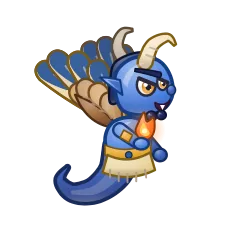
Winged Djinn
Flying
Glides through the air in groups and drops fireballs. It passes over obstacles.
Teaches: aiming on the move
-
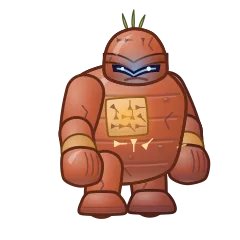
Clay Golem
Tank
Slow and very tough. When the cuneiform on its body glows, it sends out a wave of punches around it.
Teaches: choosing priorities
-
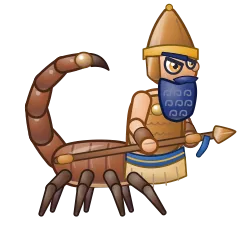
Scorpion Man
Guardian
In the epic, the guardian of the mountain's gate. It jabs with a spear and stings from behind with its tail.
Teaches: threats from two sides
-
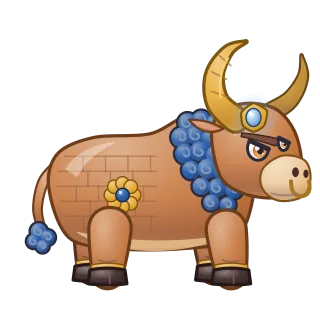 Elite
Bull of Heaven
Elite
The bull Ishtar sends in tablet VI of the Epic of Gilgamesh. It paws the ground for 0.8 s (red line) and charges in a straight line; at the end of the charge it bellows and 3 red pit rings open around it (they last 4 s). After a charge it is stunned for 1.2 s. The lapis stone between its horns is its weak point (×2 damage).
Teaches: punishing after a charge
From the game
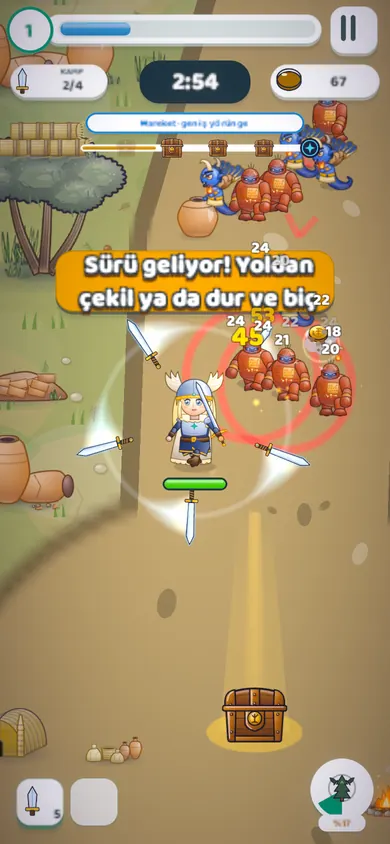
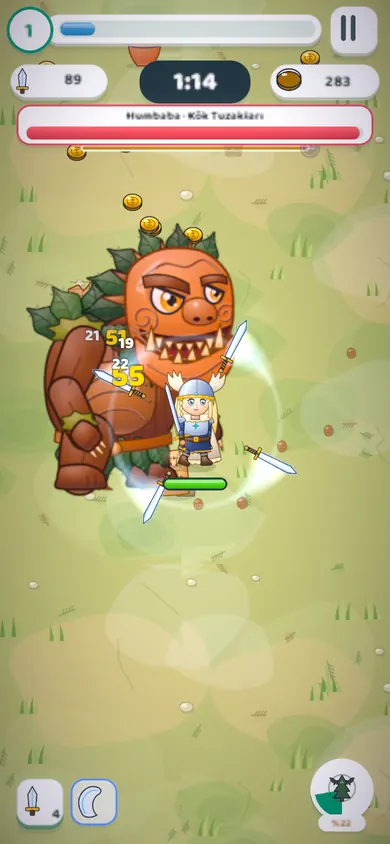
Screenshots show the game's Turkish interface.
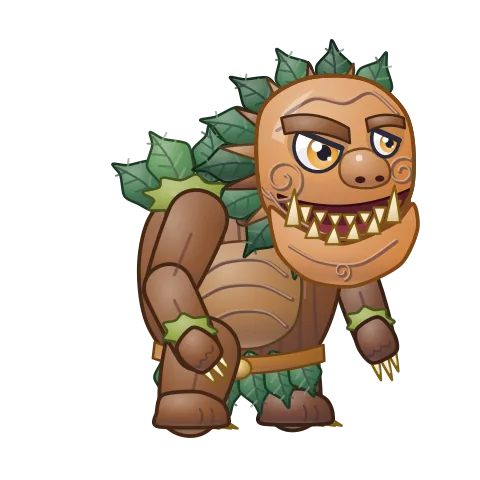
Boss · map 20
Humbaba
The guardian of the Cedar Forest in the Epic of Gilgamesh.
| Phase and health | What it does | Counter |
|---|---|---|
| Root Traps100–70% | Roots burst from the ground; red dashed rings appear on the ground 1.1 s before. | Stay outside the rings. |
| Cedar Storm70–35% | A rain of leaves and cones. | The purple cones can be parried. |
| Seven Auras35–0% | It dons the seven auras of terror from the epic. | Each aura has to be broken one by one with your swords. |
First victory reward
- Bronze Sickle Sword blueprint
- Cedar Guardian charm
Phases and numbers come from the current version of the game and may change with balance updates.
The realm's kit
The realm's own weapon, armour set and myth power.
Realm weapon
Bronze Sickle Sword
A bronze sickle sweeps a full circle around the hero; it pulls the enemies it cuts toward the ring of swords.
Armour set
Cedar Guardian
2 pieces: Hero mastery 15% cheaper. 4 pieces: Stand still for 1 s for a root field: enemies inside are 30% slower.
Myth power
Cedar Shadow
Temporary shadow swords join the orbit; they briefly exceed the 8-sword limit.
Sources
- Gilgamesh and Huwawa (version A): translation · Electronic Text Corpus of Sumerian Literature (ETCSL), University of Oxford
- Gilgamesh and the Bull of Heaven: translation · Electronic Text Corpus of Sumerian Literature (ETCSL), University of Oxford
- The Epic of Gilgamesh, Tablet II (translation by Maureen Gallery Kovacs) · Academy for Ancient Texts
- The Epic of Gilgamesh, Tablet VI (translation by Maureen Gallery Kovacs) · Academy for Ancient Texts